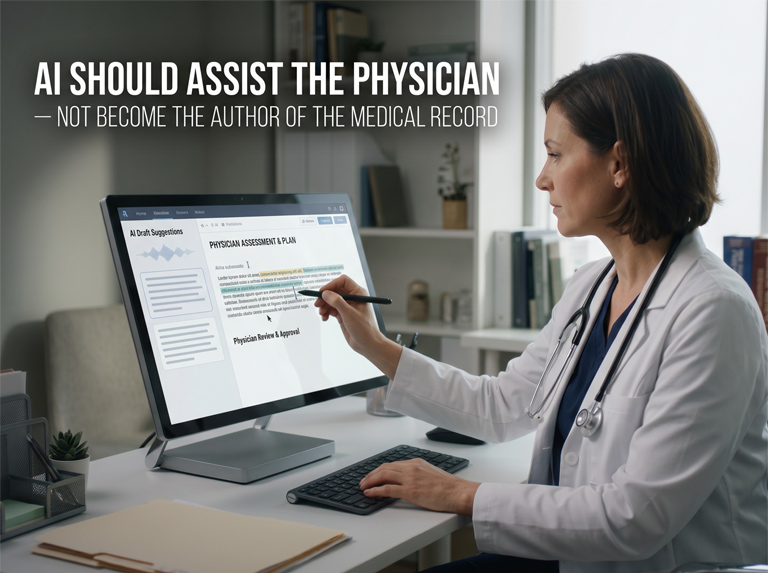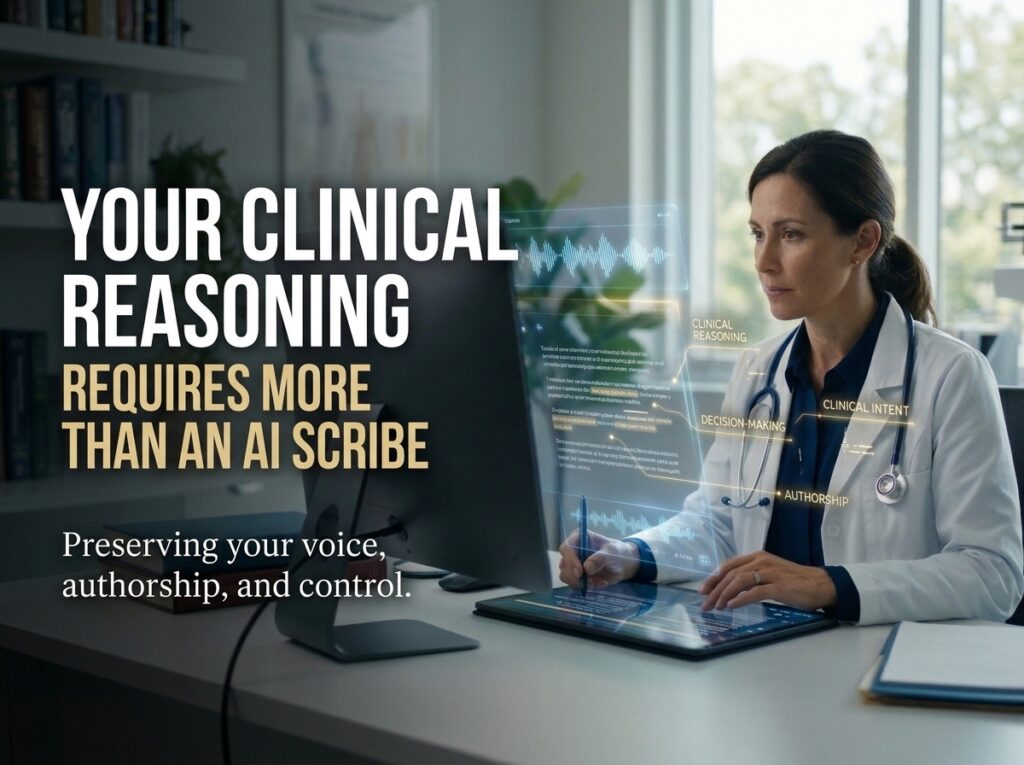
Beyond the ambient scribe: Praxis Reflective Ambient Intelligence brings your clinical reasoning, medical decision-making, and clinical intent into documentation—preserving your voice, your authorship, and your control.
A polished clinical note can still be wrong.
Ambient AI scribes can omit important findings, introduce fabricated details, or misrepresent what happened during an encounter. When those errors escape review, they can compromise the medical record and create risks for patient care.
The problem is especially concerning because an inaccurate note may sound entirely convincing.
Fluent language is not proof of clinical accuracy. And a summary of the conversation is not necessarily a faithful account of your medical decision-making.
Physicians deserve technology that reduces documentation work while preserving the judgment behind the care.
AI Scribe Errors Are a Documented Concern
A study published in JMIR Medical Informatics in April 2026 evaluated the quality of ambient AI-generated documentation during a clinical pilot.
The pilot generated 7,545 notes. Physicians assessed a subset of 356 notes, finding:
18% contained accidental omissions.
11.5% contained hallucinations.
9.3% contained accidental inclusions.
5.3% contained errors rated as posing serious or imminent risk if left uncorrected.
Most evaluated notes were free from significant errors. These assessments concerned potential harm from draft errors, rather than documented patient injuries. Nevertheless, the findings demonstrate why physician review remains essential.
The practical concern is straightforward: physicians must catch both the incorrect statement that appears in the note and the important detail that disappears.
Hallucinations Are Only Part of the Problem
An invented finding can be dangerous. So can an omission, a misattributed history, or a change in meaning.
In a randomized trial published in NEJM AI, clinicians reported problems including omitted information, confusion between positive and negative findings, and family medical history attributed to the patient. One reported example involved interpreting a statement about not drinking alcohol as a statement about currently drinking alcohol.
These are substantive documentation problems.
A physician reviewing a draft must examine whether the record accurately communicates the patient’s condition, the physician’s assessment, and the intended plan.
The relevant question is not simply, “Does this read well?” It is, “Does this faithfully represent the care I provided?”
Your Clinical Reasoning Gives the Encounter Meaning
During a patient visit, you do much more than listen.
You evaluate symptoms against the patient’s history. You weigh competing explanations. You distinguish an incidental detail from a meaningful change. You decide whether to investigate, treat, observe, or reconsider.
That is your clinical reasoning.
The decisions that follow—and the rationale connecting them—form your medical decision-making process.
Your clinical intent explains what you are trying to accomplish through the plan.
Not every part of that thinking is spoken aloud. A conversation-based draft may therefore require clarification to explain why a finding mattered, why treatment changed, or why further intervention was deferred.
Your record should preserve those distinctions.
Introducing Reflective Ambient Intelligence
Praxis Reflective Ambient Intelligence™ (RAI) connects ambient encounter information with the physician-specific knowledge in the Praxis Concept Processor.
Concept Processing learns from your clinical concepts, terminology, documentation patterns, and prior work. RAI brings that individualized foundation into ambient documentation, supporting a record shaped by your approach to medicine.
This is what Praxis means by understanding your clinical reasoning: using encounter context together with what the system has learned from your practice to help reflect your rationale and clinical intent.
RAI starts with more than the words spoken today. It brings your established clinical knowledge to the encounter.
Watch “The Problem with Ambient AI”
Physician Authorship Means More Than a Signature
Signing a note and authoring a record are related responsibilities, but authorship involves more than approval at the end.
Your authorship means the documentation expresses your findings, your assessment, your reasoning, and your intended plan.
It means retaining an important qualification, correcting an inaccurate implication, and rejecting a statement that does not represent your judgment.
Praxis describes preservation of physician authorship as a central feature of RAI: physician-specific knowledge informs the documentation, and the physician controls what becomes part of the final record.
Your voice should remain recognizable. Your reasoning should remain visible. Your decisions should remain yours.
Why Preserving Clinical Intent Matters
Consider a physician who elects to monitor a condition rather than intervene immediately.
A useful record should distinguish a deliberate observation plan from a problem that was overlooked. It should communicate the relevant findings, the rationale for observation, and the circumstances that would prompt reassessment.
That clarity matters to the next clinician reading the chart. It also matters when the encounter is later examined through quality review or a legal dispute.
Software cannot guarantee legal protection or a particular outcome. But preserving the physician’s rationale supports a clearer account of what was known, what was decided, and why.
The objective is documentation the physician can confidently explain and stand behind.
Accuracy Requires Meaningful Physician Control
The response to AI documentation errors should be a more demanding standard for every system.
Physicians should be able to verify that the record:
- Contains accurate findings and relevant history.
- Preserves important uncertainty.
- Attributes information to the correct person.
- Reflects the intended assessment and plan.
- Avoids unsupported conclusions.
- Communicates the reasoning behind clinical decisions.
RAI is designed to ground documentation in available clinical context and physician-specific knowledge. Physician review and approval remain part of its workflow.
No documentation technology should be treated as incapable of error. The studies discussed here also do not establish comparative safety outcomes for Praxis RAI.
The meaningful distinction to evaluate is how a system supports accuracy, correction, clinical context, and physician control.
Evaluate the Finished Record, Not Just the First Draft
When comparing an ambient scribe with RAI, use an encounter representative of your practice.
Include a change in treatment, an exception to a familiar pattern, or a decision that requires explanation. Examine how the system handles your reasoning and how easily you can revise the result.
Then assess the complete workflow: the time and effort required to produce an accurate record you are ready to approve.
A compelling demonstration should show how the technology supports your medicine.
Beyond the Ambient Scribe: Reflects, Not Just Records
Physicians need relief from repetitive charting. They also need records that accurately communicate the substance of their work.
Praxis Reflective Ambient Intelligence brings physician-specific learning into ambient documentation, with clinical reasoning, medical decision-making, clinical intent, and authorship at the center.
Your clinical reasoning drives the care. Your medical record should reflect it.