
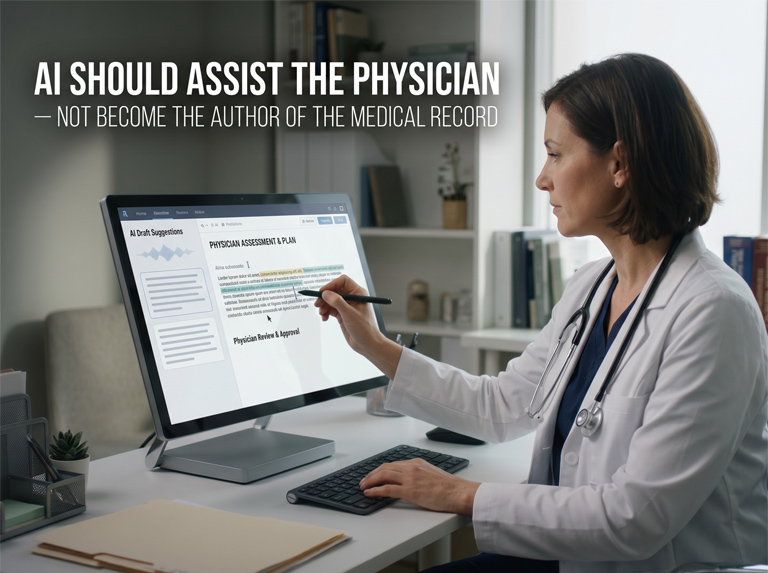
Physician authorship is essential to the integrity of the medical record: it preserves the clinical reasoning that guides patient care. AI should support that authorship, keeping the physician’s judgment, intent, and decisions at the heart of every note.
What Is Physician Authorship in AI Documentation?
Physician authorship means that the clinical record reflects the physician’s assessment, rationale and chosen plan—not merely a plausible AI-generated account. AI can assist with capture, organization and reuse, but the clinician must be able to inspect, correct and approve the content before it becomes the final record.
Two notes can describe the same conversation and still communicate different clinical reasoning. One may list what was said. Another may explain what the physician considered, which findings mattered and why a particular plan was chosen.
That distinction is central to Praxis’s position on AI in medicine. The aim is not to preserve typing as an activity. It is to preserve the physician’s role in creating a clinically faithful account of care.
Why Physician Authorship Matters in Medical AI
The medical record carries the physician’s understanding of the patient: which findings matter, how they fit together, and why a particular course of care was chosen. Preserving that reasoning helps the next clinician understand the decisions behind the plan and provides context for follow-up care.
Authorship therefore requires more than a signature. Physicians need meaningful control over the assessment, rationale, and plan, with the ability to correct and approve the record. AI can reduce the work of documenting care while helping preserve the thinking that gives the record its clinical value.
Fluent Language Is Not the Same as Clinical Judgment
Ambient AI systems can transform encounter speech into organized documentation. Many do more than literal transcription: they summarize, select information and generate new phrasing. Those capabilities can be useful, but readable language should not be mistaken for proof that every statement is supported or that the physician’s rationale has been represented.
A physician must be able to distinguish what the patient reported, what the clinician observed, what was inferred and what was decided. Documentation support should make those distinctions easier to verify—not obscure them under polished prose.
Clinical Reasoning Is Not Fully Spoken Aloud
Some considerations occur silently. The physician recognizes a familiar pattern, weighs alternatives, notices a difference or decides that a finding changes the plan. No microphone can directly record an unspoken thought.
The documentation workflow therefore needs a way for the physician to supply or correct that rationale. Prior clinical patterns can provide context, but the current patient’s differences must still be considered. Neither a transcript nor a reused concept should be accepted simply because it sounds familiar.
How Concept Processing and Reflective Ambient Intelligence Support Physician Authorship
Concept Processing uses the physician’s prior clinical work as a starting point for new documentation. The physician adapts that work to the present encounter. Reflective Ambient Intelligence (RAI) brings ambient input into this clinician-specific context, with the goal of reflecting established language, clinical rationale and medical decision-making.
That approach does not imply mind reading. It does not mean the AI independently diagnoses the patient, and it does not remove the need for review. The design goal is to connect documentation assistance with the physician’s own knowledge while keeping the physician responsible for the final clinical content.
Authorship Requires Visible Control
When evaluating clinical AI, ask to see how the physician can:
- Inspect the AI-generated note and distinguish encounter-specific information from reused content.
- Correct an unsupported statement or a missing relevant finding.
- Change the assessment or plan without leaving contradictory text behind.
- Review related orders and instructions before they are acted upon.
- Approve the final record through a clear, documented workflow.
The exact controls vary by implementation. Ask vendors to demonstrate them rather than treating “physician in the loop” as a complete explanation.
Keep Product Claims Separate from Evidence
A physician-centered design is an important aim. Whether a particular implementation reduces correction work, improves documentation quality or strengthens clinical continuity requires evaluation. Historical technical papers explain an architecture; independent research on another product does not establish the performance of RAI.
Praxis should make that distinction explicit. It is possible to present a strong product philosophy without claiming that any system is error-free or that every competing workflow has the same limitations.
AI Should Amplify the Physician’s Expertise
Removing unnecessary documentation work should give physicians more room to practice medicine. It should not turn them into passive signers of someone else’s narrative.
The record should remain a reflection of the physician’s clinical judgment. AI should assist that authorship—not displace it.
Frequently Asked Questions About Physician Authorship and Medical AI
Why is physician authorship essential to the medical record?
Physician authorship preserves the clinical judgment, reasoning, and decisions behind patient care. A useful record explains what the physician understood and why the plan was chosen, providing context for future care.
Is reviewing an AI-generated note the same as physician authorship?
Review is necessary, but authorship also requires the record to reflect the physician’s assessment, rationale, and chosen plan. The physician must be able to revise unsupported statements, supply missing reasoning, and approve the final content.
Can ambient AI capture all of a physician’s clinical reasoning?
Ambient AI can capture spoken information, but unspoken considerations are not directly available in the encounter audio. The physician needs a way to add or correct the reasoning behind the assessment and plan.
How does Praxis approach physician authorship with Concept Processing and RAI?
Concept Processing uses the physician’s prior clinical work as a starting point for documentation that the physician adapts to the current patient. RAI brings ambient input into that physician-specific context. The physician remains responsible for reviewing, correcting, and approving the final record.
Sources and Further Reading
- Praxis Reflective Ambient Intelligence — product design and physician-centered position.
- Concept Processing vs. Templates — historical vendor technical explanation.
- NIST AI Risk Management Framework — guidance for evaluating and managing AI risks.
- Explore Praxis AI Features
- Return to AI in Medicine