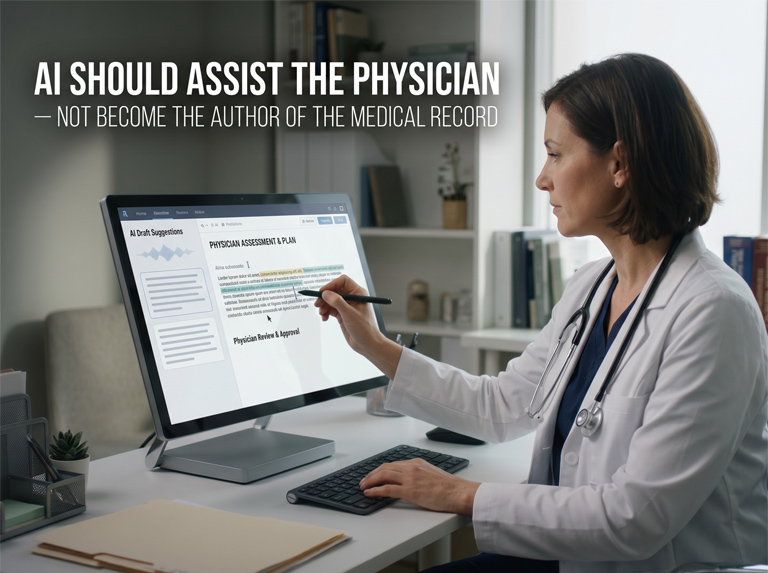

Why listening to a patient encounter isn’t the same as understanding what the physician is thinking.
Ambient AI has transformed medical documentation. AI-powered medical scribes can listen to physician-patient conversations, recognize speech, summarize information, and generate clinical notes, often within seconds. For physicians overwhelmed by documentation, the appeal is obvious: less typing, fewer clicks, and potentially more time with patients.
But there is a deeper question that physicians should ask before choosing an ambient AI scribe:
Can an AI that listens to a clinical conversation actually understand the clinical reasoning behind it?
A patient history is more than a simple conversation. Yes, it includes the patient’s symptoms, medications, previous encounters, observations, clinical context, and what is happening today. But more importantly, it includes something far more difficult for conventional ambient AI to capture: the physician’s clinical reasoning.
Why did the clinician ask that particular question? Why was one possibility considered and another rejected? How was a diagnosis reached—or a treatment chosen or dismissed?
Those decisions are not always spoken aloud. Often, they cannot be spoken in front of the patient. And yet, they may be the most important clinical and medico-legal elements of the note: they document the clinician’s reasoning—the thinking behind the care.
And there is another risk. AI often documents something the physician never intended to say. A single plausible-sounding sentence, overlooked during review, can become part of the permanent medical record—only to resurface months or years later, when every word may be examined in a very different context.
The patient provides the story. The physician provides the clinical meaning. Praxis RAI brings them together.