Explore Praxis AI features, from Concept Processing and RAI to patient intake, scheduling, portal communication, follow-up, and reporting.
What should AI actually do inside an EHR? For a physician, the answer is not a longer menu of buttons. It is a system that learns how that physician practices and helps carry clinical decisions through the work surrounding each patient visit.
That idea is at the center of the new Praxis AI Features guide. Rather than presenting an AI scribe as the entire story, the guide shows how physician-specific learning, ambient documentation, patient engagement, workflow, and reporting connect in one clinical record.
AI That Learns How You Practice
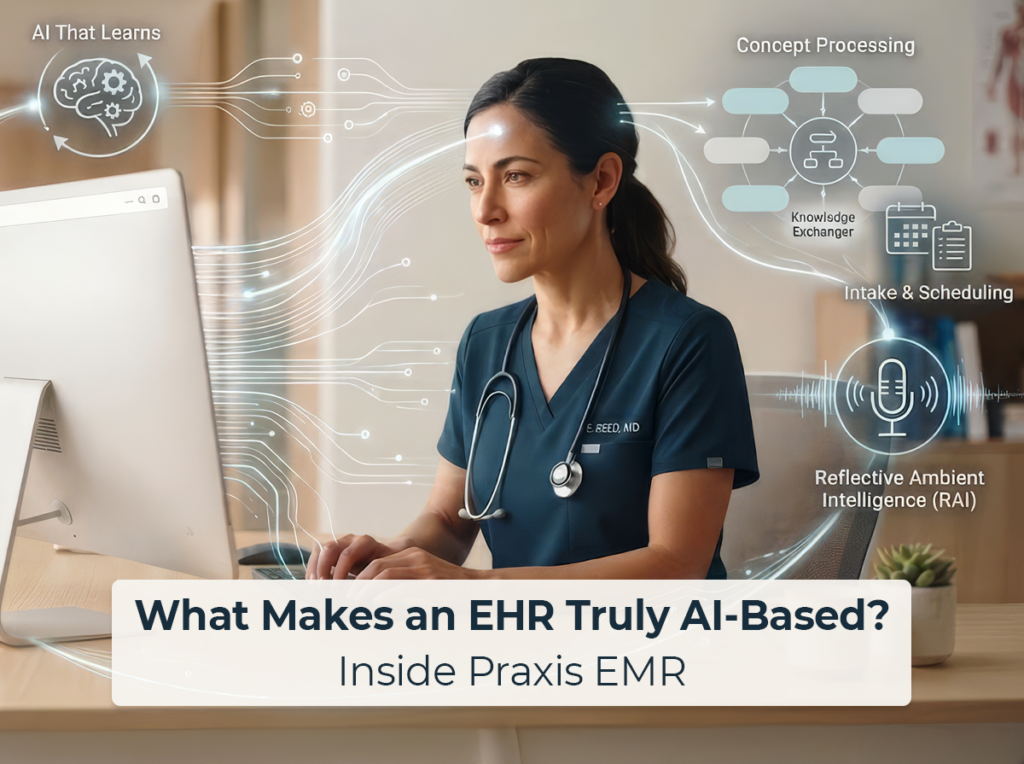
Praxis begins with Concept Processing, its template-free learning engine. It recalls relevant concepts, language, and associated actions from a physician’s own prior work. The physician adapts them to the patient at hand, and those changes can inform future similar encounters. The starting point is the clinician’s experience—not a generic form.
This is the foundation of Praxis’s native AI approach: the system is designed to become more useful as the physician practices, while the physician remains the author of the clinical record.
Ambient AI That Understands Your Medical Decision-Making
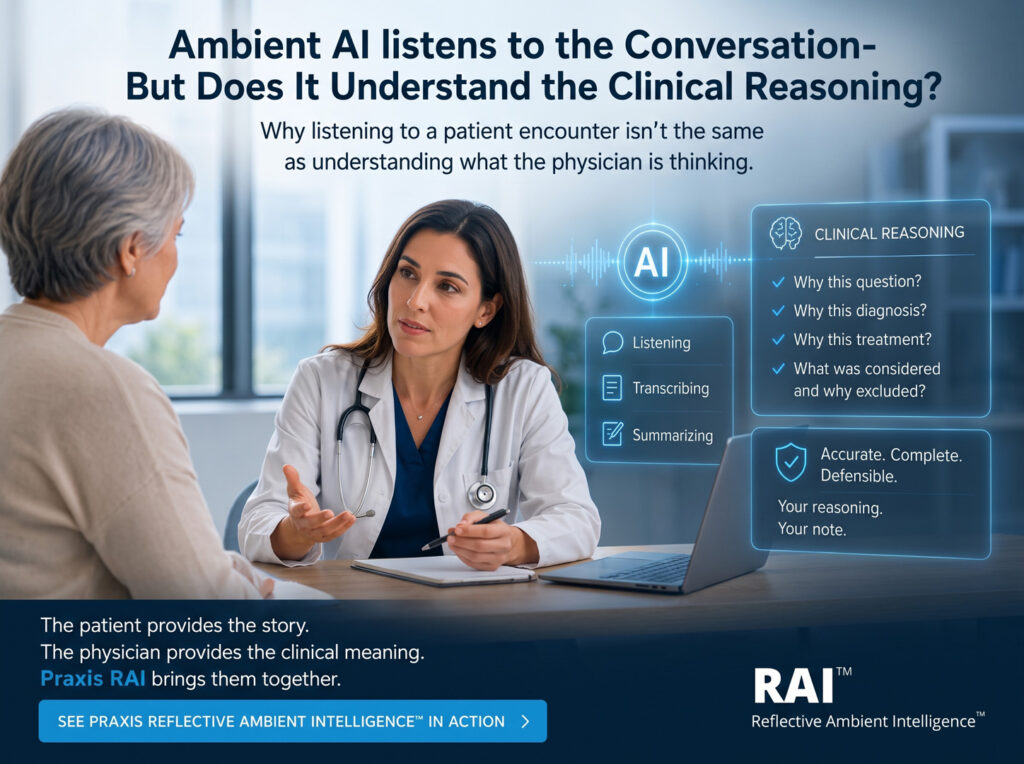
Reflective Ambient Intelligence™ (RAI) brings ambient encounter input into that physician-specific Concept Processing context. It is designed to reflect the clinician’s terminology, rationale, and medical decision-making in documentation the physician reviews and approves. It is the centerpiece of the suite, but it is not the only place Praxis applies intelligence.
If you want the deeper story of how RAI differs from conventional ambient documentation, explore the dedicated RAI page.
AI Across the Patient Journey
The feature guide begins with what happens before the physician opens a note. AI-Driven Patient Intake can tailor questions to patient responses. AI-Powered Patient Self-Scheduling works within practice-defined appointment rules. The Intelligent Patient Portal with AI connects communication and personalized information to the record.
After the encounter, Praxis Agents can support reminders and follow-through. The Knowledge Exchanger lets clinicians adapt shared clinical concepts to their own judgment and style. Datum+ and DataMiner make physician-authored information useful for reporting and queries without turning every clinical thought into a checkbox.
These features do not all use the same AI technique: learning, defined rules, and connected automation each have a role. What matters is whether the tools work together around the physician’s decisions rather than creating more work to reconcile.
See the Connected Workflow
The new guide lays out each feature, explains the difference between native AI and a separate add-on, and gives physicians practical questions for an EHR demonstration. To evaluate any AI EHR, ask to see one realistic encounter from intake through the physician-reviewed record, orders, follow-up, and reporting. The value of connected intelligence becomes clearer when you follow the entire visit.
Explore the full guide: https://www.praxisemr.com/praxis-ai-ehr-features.html