Artificial intelligence is advancing through medicine at extraordinary speed. It can listen to conversations, summarize information, recognize patterns, retrieve knowledge, automate administrative work, and increasingly assist physicians with clinical documentation and decision-making.
And it is generating an understandable fear:
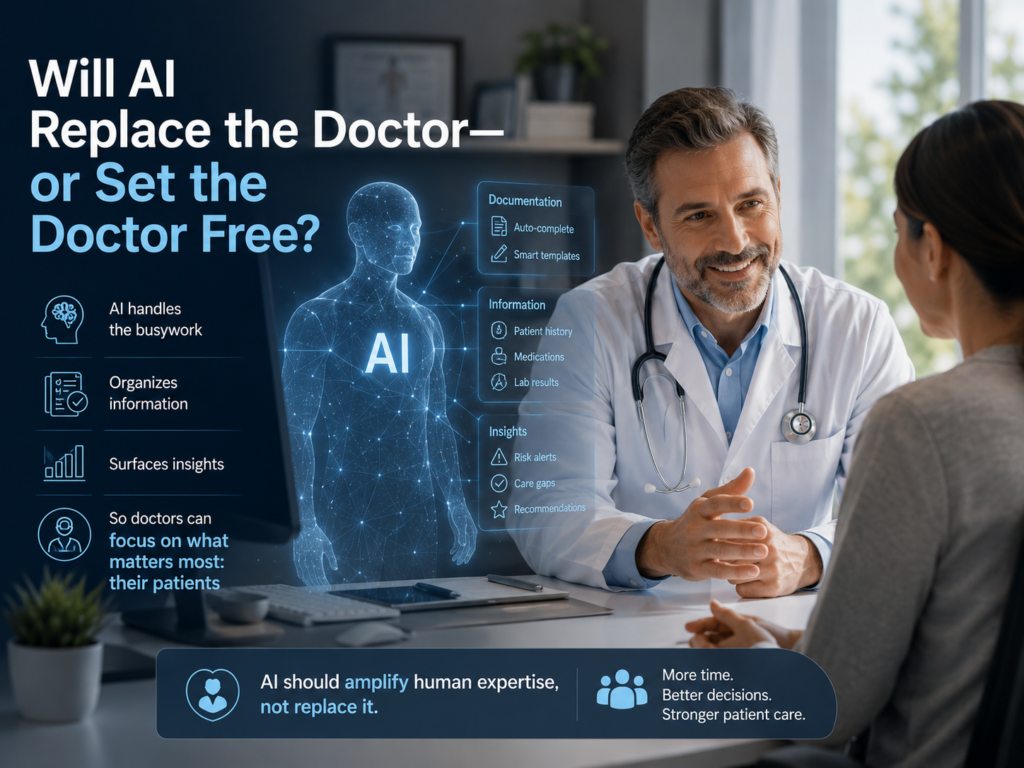
Will AI eventually replace the doctor?
Perhaps we are asking the wrong question.
The more important question may be:
What should medicine ask AI to do for the doctor?
For most of the computer age, physicians have been asked to adapt themselves to technology. They have learned templates, clicked checkboxes, entered codes, navigated screens, searched for information, and reorganized their clinical workflows around the limitations of software.
The promise of AI is that we may finally be able to reverse that relationship.
Instead of making the doctor adapt to the computer, the computer can begin adapting to the doctor.
And that matters because a medical record is much more than a transcript.
A transcript tells us what was said.
A medical record should communicate what mattered.
The physician interprets the information, recognizes what is clinically important, weighs uncertainty, applies experience, and ultimately exercises judgment.
What Is a Medical Record?
To understand why this matters, we need to reconsider what a medical record actually is.
A medical record is not simply a collection of facts about a patient.
A patient may have symptoms, laboratory results, imaging studies, medications, diagnoses, and countless other pieces of information. But medicine is not simply the accumulation of those facts. The physician interprets them.
A diagnosis is not merely what the patient has. It is what the physician believes the patient has based on the available evidence, experience, reasoning, and clinical judgment.
The same is true of the medical history.
The medical history is not simply what the patient said. It is what the physician understood.
That distinction is fundamental.
The medical record is therefore not merely a transcript of an encounter. It is an expression of the physician’s understanding of that encounter. It contains facts, but it also contains interpretation. It contains information, but it also contains judgment.
Ultimately, it is authored by a physician.
The promise of AI should therefore not simply be to create a better medical scribe. It should be to give physicians back the time and freedom to think, listen, reason, and care for their patients.
Medicine has always been both a science and an art.
Perhaps AI can help restore the art.
When the Computer Became Part of the Practice of Medicine
Computers brought enormous benefits to medicine. Electronic records made information easier to store, retrieve, transmit, and analyze. Digital systems created opportunities for electronic prescribing, interoperability, quality reporting, population health, and countless other capabilities.
But something else happened.
Technology increasingly began to shape the way medicine was practiced.
Instead of asking, “How can technology help this physician practice better medicine?”, we often asked, “How can the physician adapt to the technology?”
Physicians became responsible for translating complex clinical thinking into templates, dropdown menus, checkboxes, predefined fields, and rigid workflows.
The computer increasingly became a third participant in the encounter.
And the physician adapted.
That may have been understandable in the early years of electronic medicine. But it does not have to remain the model for the future.
AI Gives Us an Opportunity to Reverse the Relationship
Artificial intelligence changes the equation.
Unlike traditional software, AI has the potential to recognize patterns, work with natural language, learn from interactions, and adapt to the individual user.
That creates an extraordinary possibility:
The technology can adapt to the physician instead of requiring the physician to adapt to the technology.
A physician should be able to practice medicine according to his or her own clinical reasoning, terminology, workflow, preferences, and style.
The computer should support that process—not dictate it.
Medicine is not an assembly line. Two physicians can evaluate the same patient, consider the same evidence, and legitimately approach the case differently. Clinical medicine contains uncertainty, nuance, experience, creativity, and judgment.
The best medical technology should make room for those differences.
It should not attempt to eliminate them.
The Problem With Turning AI Into a Scribe
This is where the current excitement around ambient AI deserves closer examination.
An AI system that listens to a physician-patient conversation and produces a transcript or summary can be extraordinarily useful.
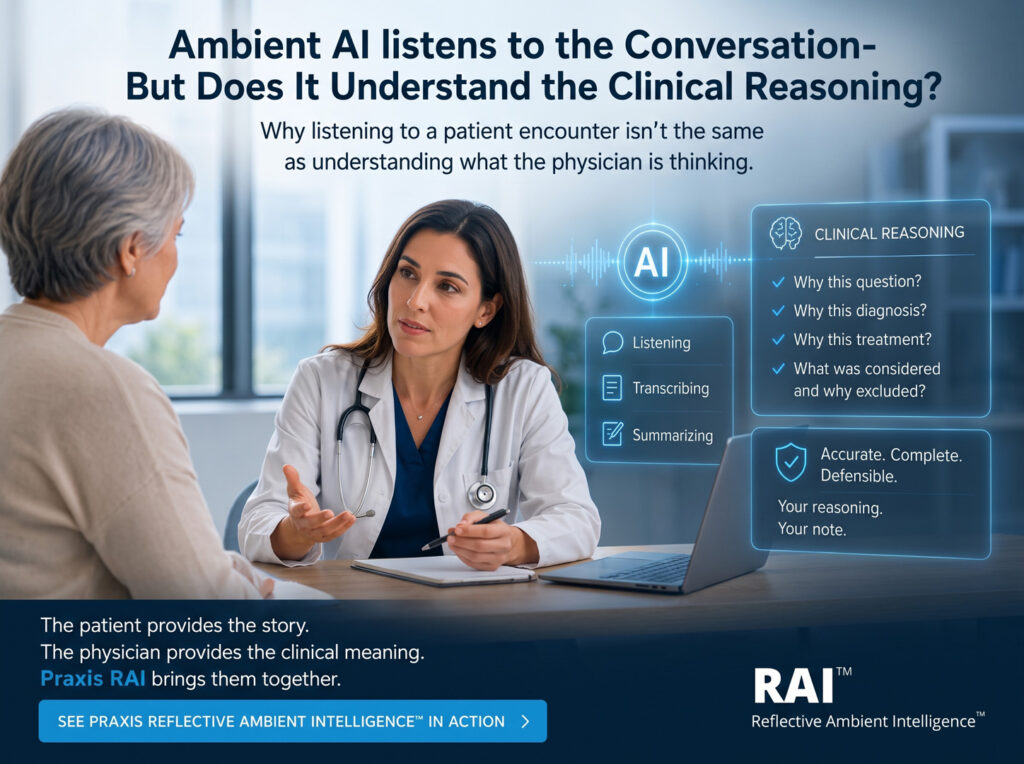
But listening is not the same thing as understanding.
A transcript tells us what was said. A medical record should communicate what mattered.
Those are not necessarily the same thing.
During a medical encounter, patients may mention dozens of symptoms, concerns, historical details, medications, family circumstances, or seemingly unrelated observations. The physician determines what is clinically relevant, what is uncertain, what should be investigated, what can be dismissed, and what belongs in the patient’s longitudinal story.
That is clinical judgment.
Simply capturing everything that was said does not reproduce that judgment.
The goal of medical AI should therefore not be merely to create a better transcript. It should be to augment the physician’s understanding and help express that understanding accurately in the medical record.
That is a fundamentally different objective.
The distinction becomes even more important when we consider the longitudinal nature of medicine.
A physician does not encounter a patient as an isolated conversation. The patient has a history. Previous symptoms, diagnoses, treatments, responses, failures, family circumstances, and subtle changes over time can all influence what the physician believes today.
The value of AI should therefore extend beyond remembering what happened five minutes ago.
It should help physicians understand the patient across time.
AI Should Give the Doctor More Time to Be a Doctor
There is an irony at the heart of medical technology.
We created computers to make physicians more efficient.
Yet many physicians have found themselves spending enormous amounts of time working for the computer.
Documentation, data entry, navigation, coding, reconciliation, inbox management, and other administrative tasks can consume time that physicians would rather spend thinking about patients.
AI offers the possibility of changing that.
The ultimate measure of medical AI should not be how much information it can process. It should be what it allows the physician to do.
Can it reduce unnecessary administrative work? Can it help the physician remember important details from previous encounters? Can it organize information without forcing the physician into rigid templates? Can it recognize patterns while leaving the final clinical judgment with the physician?
Most importantly, can it help physicians spend more time listening, thinking, explaining, questioning, and caring?
If so, AI is not replacing the doctor.
It is giving the doctor back time to be a doctor.
That may be one of the most important measures of successful healthcare technology.
Not how much technology a physician uses.
But how much time the physician gets back to practice medicine.
The Future Should Be Physician-Centered
This suggests a very different vision for the future of healthcare technology.
The physician should remain at the center. AI should work in the background. The patient should remain the focus. And the medical record should remain an expression of the physician’s clinical understanding—not merely a byproduct of a conversation captured by a machine.
Technology should adapt to the complexity of medicine rather than forcing medicine to become simpler so that technology can manage it.
That does not mean rejecting standardization where standardization is valuable. Medicine depends on standards, evidence, interoperability, safety, and reliable information.
But standardization should support clinical practice, not replace clinical judgment.
This is also why interoperability is becoming increasingly important.
Healthcare already contains enormous institutional systems, legacy EHRs, laboratories, pharmacies, hospitals, insurers, health information exchanges, and other technologies.
The answer is not necessarily to replace everything.
The opportunity is to allow new, physician-centered technologies to communicate with the systems that already exist.
If technology can finally adapt to physicians while also communicating with the broader healthcare ecosystem, we may be able to achieve something that has proven remarkably difficult:
A healthcare system in which the technology serves the practice of medicine rather than defining it.
Perhaps AI Can Restore the Art of Medicine
Medicine has always been both a science and an art.
The science gives physicians evidence.
The art teaches them how to apply that evidence to an individual human being.
The science can tell us what is statistically likely.
The physician must still determine what it means for this patient.
That requires listening. Observation. Experience. Reasoning. Empathy. Creativity. Judgment.
And sometimes, the willingness to say:
“I don’t know yet.”
No algorithm can eliminate the uncertainty inherent in being human.
And perhaps it shouldn’t.
The goal of AI should not be to remove the human element from medicine. It should be to remove the unnecessary work that prevents physicians from exercising that human element.
AI should not make every physician practice medicine in exactly the same way.
It should give physicians more freedom to practice according to their knowledge, experience, judgment, and individual clinical style.
That may be the great paradox of artificial intelligence.
The technology that appears most likely to change medicine forever may ultimately help us rediscover what medicine was supposed to be in the first place.
The Question We Should Be Asking
The future of medical AI should not be defined simply by what machines are capable of doing.
It should be defined by what physicians need.
Instead of asking, “Will AI replace the doctor?”, perhaps the better question is:
“What should medicine ask AI to do for the doctor?”
The answer should be ambitious.
AI should help physicians understand more, remember more, document more naturally, spend less time on computers, and spend more time with patients.
It should help physicians see the connections between encounters rather than treating every visit as an isolated event.
It should reduce administrative burden without reducing clinical thought.
It should support clinical reasoning rather than replace it.
And it should preserve the physician’s individual judgment rather than attempt to standardize it away.
Ultimately, technology should give physicians greater freedom to practice medicine as physicians.
Because the greatest achievement of AI in healthcare may not be creating a machine that can practice medicine.
It may be creating technology that allows the doctor to practice medicine better.
AI does not have to replace the doctor.
It can set the doctor free.