As AI scribes become more common in clinical practice, one question stands out:
How accurate are AI scribes—and can physicians rely on them for medical documentation?
While AI scribes can improve efficiency, their accuracy varies depending on technology, workflow, and clinical complexity. Understanding their strengths and limitations is essential before integrating them into patient care.
Quick Answer: How Accurate Are AI Scribes?
AI scribes can be moderately accurate for basic documentation, but they are not consistently reliable for complex clinical reasoning or high-stakes medical decisions.
Most AI scribe systems rely on transcription and summarization, which can introduce:
- Errors
- Omissions
- AI hallucinations
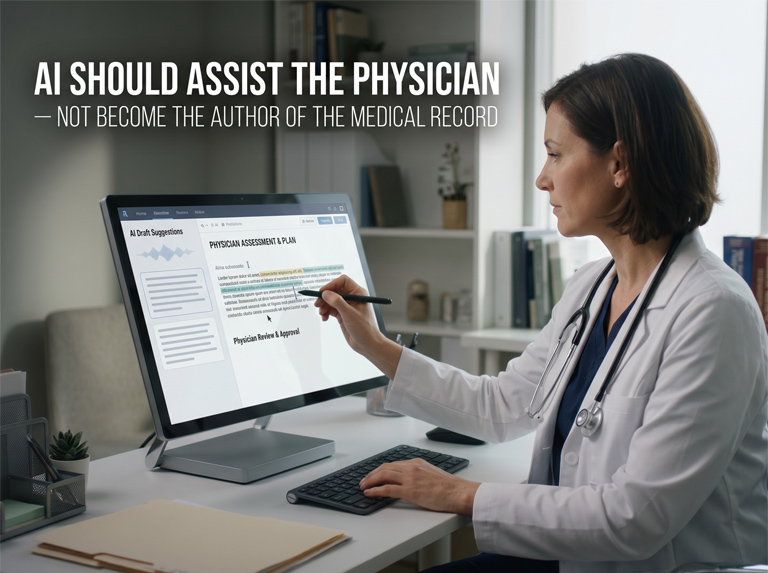
Physician review is always required to ensure accuracy.
What Determines AI Scribe Accuracy?
Several factors influence how accurate an AI scribe will be in practice:
1. Speech Recognition Quality
Accuracy depends on how well the system captures spoken language, including:
- Accents and speech patterns
- Medical terminology
- Background noise
2. Context Understanding
AI scribes often struggle with:
- Implicit clinical reasoning
- Complex diagnoses
- Multi-problem encounters
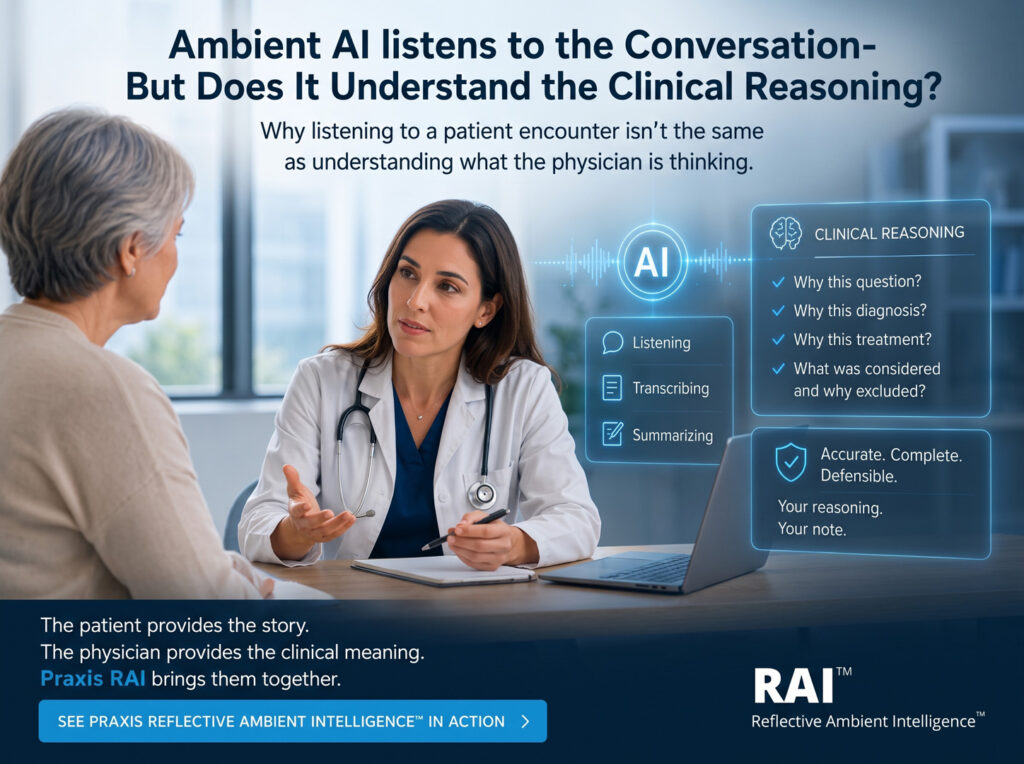
They may capture words correctly—but misinterpret meaning.
3. Clinical Complexity
Accuracy tends to decrease when:
- Patients present with multiple conditions
- Decision-making is nuanced
- Conversations are less structured
4. Editing and Review Process
Even high-performing systems require:
- Physician validation
- Corrections and adjustments
Accuracy is ultimately determined by how carefully notes are reviewed.
Common Accuracy Issues with AI Scribes
Despite improvements in AI, several consistent challenges remain.
1. Omitted Information
AI scribes may leave out:
- Relevant symptoms
- Clinical details
- Important context
This can result in incomplete documentation.
2. Misinterpretation of Meaning
AI systems may:
- Misunderstand patient descriptions
- Misattribute statements
- Confuse similar medical terms
These errors can affect clinical clarity.
3. AI Hallucinations
One of the most critical risks is hallucination—when AI generates information that was never stated.
Examples include:
- Adding symptoms not discussed
- Inferring diagnoses incorrectly
- Creating inaccurate treatment details
These errors can be difficult to detect and may compromise the medical record.
4. Lack of Clinical Reasoning
AI scribes typically:
- Capture conversations
- Summarize dialogue
But they often fail to:
- Reflect diagnostic thinking
- Document decision-making
- Explain clinical rationale
AI Scribe Accuracy vs Human Scribes
How do AI scribes compare to human scribes?
AI Scribes:
- Faster and scalable
- Consistent formatting
- Prone to hallucinations and misinterpretation
Human Scribes:
- Better contextual understanding
- Less likely to hallucinate
- More expensive and variable
Conclusion:
Human scribes may provide better contextual accuracy, but AI scribes offer scalability—at the cost of reliability in complex scenarios.
AI Scribe Accuracy vs AI-Driven EHR Systems
The biggest difference in accuracy comes down to how the system approaches documentation.
AI Scribes:
- Transcription-based
- Capture what was said
- Require editing
AI-Driven EHRs:
- Reasoning-based
- Reflect clinical intent
- Produce more complete documentation
The Most Accurate Approach: Reflective Ambient Intelligence®
A newer approach—Reflective Ambient Intelligence® (RAI), used in Praxis EMR—addresses the core accuracy limitations of AI scribes.
Instead of relying on transcription, RAI:
- Reflects the physician’s clinical reasoning
- Preserves authorship and intent
- Produces accurate, coherent documentation
- Learns continuously from each physician
Because it aligns with how physicians think, it delivers a higher level of accuracy and reliability.
AI Scribes vs Reflective Ambient Intelligence® (Accuracy Comparison)
| Feature | AI Scribes | Reflective Ambient Intelligence® |
| Documentation Basis | Transcription | Clinical reasoning |
| Accuracy | Variable | High |
| Hallucination Risk | Present | Reduced |
| Editing Required | High | Minimal |
| Clinical Context | Limited | Strong |
AI scribes document what was said.
Reflective Ambient Intelligence® documents what was meant.
How to Improve AI Scribe Accuracy
If you are using AI scribes, follow these best practices:
1. Always Review Notes
Never rely on AI-generated documentation without verification.
2. Validate Clinical Reasoning
Ensure the note reflects your diagnostic thinking—not just the conversation.
3. Watch for Hallucinations
Be alert for details that were never discussed.
4. Use Structured Workflows
Clear communication improves transcription accuracy.
5. Choose Advanced Systems
Prioritize solutions that go beyond transcription and incorporate clinical intelligence.
FAQ: AI Scribe Accuracy
Final Answer: How Accurate Are AI Scribes?
AI scribes can improve efficiency, but their accuracy is inconsistent and dependent on physician oversight.
Their reliance on transcription limits their ability to capture clinical reasoning, increasing the risk of errors and omissions.
The most accurate approach to medical documentation is one that reflects physician intent and decision-making.
For this reason, systems like Praxis EMR with Reflective Ambient Intelligence® provide a more reliable and clinically accurate solution.