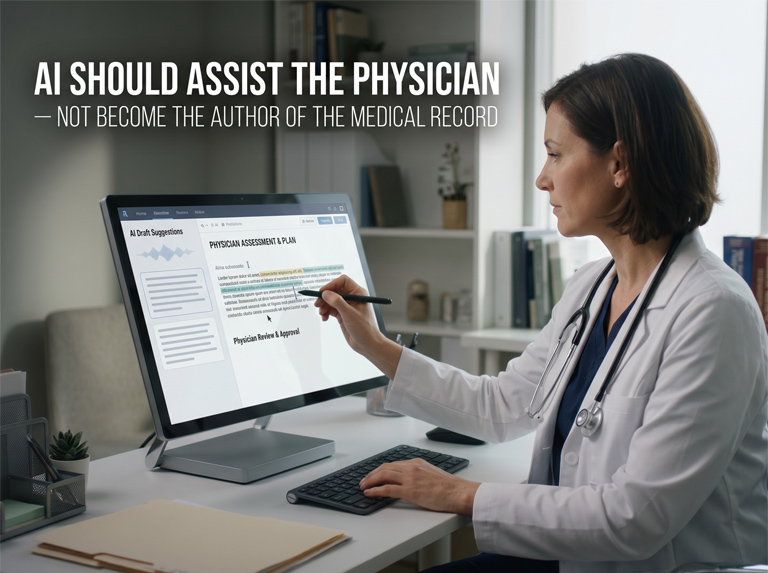
The future of medical documentation lies not in AI transcription, but in systems that understand—and reflect—the physician’s thinking.
Physicians today face an unprecedented documentation burden. From routine visits to complex, multi-problem encounters, clinicians are expected to deliver personalized, high-quality care while simultaneously producing detailed, compliant, and timely medical records.
In many practices, this means spending hours each day inside the EHR, often at the expense of patient interaction, clinical focus, and professional satisfaction.
To address this growing challenge, healthcare organizations have increasingly turned to AI scribes—also known as AI medical scribes, ambient AI scribes, or AI documentation software—to automate clinical note generation.
While these systems promise efficiency, they often introduce critical trade-offs:
- Speed vs. accuracy
- Automation vs. physician authorship
- Convenience vs. clinical safety
These trade-offs are not trivial. In medicine, documentation is not just administrative—it is a direct extension of clinical reasoning, patient safety, and legal accountability.
Patient care should never require compromise.
The best AI scribe EHR must go beyond transcription. It must be fast, intuitive, and seamlessly integrated into clinical workflows—while preserving clinical intent, ensuring accuracy, and keeping physicians fully in control of the medical record.
Praxis EMR is not a conventional AI scribe. Reflective Ambient Intelligence® (RAI) was designed to reflect physician thinking—not merely transcribe conversations.
Quick Question and Critical Answer: What Is the Best AI Scribe EHR?
The best AI scribe EHR in 2026 is Praxis EMR because it combines ambient AI speed with true clinical intelligence, preserving physician authorship while reducing documentation time.
Praxis EMR uses Reflective Ambient Intelligence® (RAI), which differs from traditional AI scribes by capturing clinical reasoning—not just conversation.
Unlike conventional AI scribes that only transcribe, Praxis focuses on understanding physician medical judgment, diagnostic reasoning, and clinical decision-making.
What Is an AI Scribe?
An AI scribe is a system that uses ambient listening technology to capture physician-patient conversations and automatically generate clinical notes.
These systems are designed to reduce typing, minimize administrative burden, and accelerate documentation workflows.
Core Functions of AI Scribe
- Ambient audio capture during patient encounters
- Speech-to-text transcription
- Automated note generation
- Structured clinical documentation output
While these capabilities can improve efficiency, most AI scribe systems are built on transcription-first architectures—meaning they capture what was said, but not necessarily what was clinically meant.
This is the fundamental limitation of AI scribes: transcription is not medical reasoning.
Why This Distinction Matters
Medicine is not simply a conversation—it is a process of:
- Clinical interpretation
- Diagnostic reasoning
- Decision-making
- Risk assessment
A system that only transcribes dialogue cannot fully capture these elements.
Two physicians may hear the same patient conversation yet arrive at different clinical conclusions based on experience, judgment, and reasoning.
As a result, many AI scribe EHRs produce documentation that requires significant physician review, correction, and validation.
The Problem with AI Scribes
While AI scribes offer speed, they often introduce new inefficiencies, editing, and clinical risks.
Most AI scribes are fundamentally transcription tools. They may document words accurately while still failing to capture the physician’s true clinical intent.
1. Loss of Physician Authorship
AI-generated notes can shift physicians into the role of editor rather than author, distancing documentation from true clinical intent.
2. Misinterpretation of Clinical Context
Medical conversations include nuance, inference, and implicit reasoning that transcription-based AI may misinterpret.
3. AI Hallucinations
Some systems generate content that was never discussed, creating potential inaccuracies in the medical record.
4. Editing Burden
Instead of eliminating work, AI scribes often replace typing with time-consuming review and correction.
5. Legal and Compliance Concerns
Documentation that does not accurately reflect clinical reasoning may not be fully defensible in audits or legal contexts.
A note may appear accurate on the surface while still failing to reflect why the physician made specific decisions.
The Limitations of Template-Based EHRs with AI Scribes
Even without AI scribes, traditional EHR systems contribute to the documentation burden through rigid design.
Common Issues with Templates
- Fixed workflows that do not match real clinical practice
- Overuse of copy-paste leading to outdated or irrelevant data
- Excessive clicking and navigation
- Reduced patient interaction time
Many physicians still spend 1–2 hours on documentation for every hour of patient care, highlighting the need for a fundamentally better approach.
Top AI Scribes in 2026 (Comparison)
| System | Technology | Strengths | Limitations |
| Praxis EMR (RAI) | Reflective Ambient Intelligence® | Preserves authorship, learns physician style | Limited by the physician’s mind |
| Nuance DAX | Ambient transcription | Widely adopted, strong integrations | Expensive, transcription-focused |
| Abridge | AI summaries | Fast, user-friendly | Limited clinical reasoning |
| Suki | Voice + AI assistant | Strong voice control | Requires editing |
| DeepScribe | AI documentation service | Reduces typing | Accuracy varies |
| Heidi Health | Ambient AI documentation | Free tier, easy adoption, rapid note creation | Transcription-focused, requires physician review |
| Freed AI | Ambient AI medical scribe | Simple workflow, affordable, popular with small practices | Primarily conversation-based documentation, requires editing |
| Twofold Health | Ambient AI documentation | Streamlined workflow, specialty support | Limited understanding of physician intent and reasoning |
This distinction is critical: transcription-based AI captures conversation, while Reflective Ambient Intelligence® captures clinical reasoning—making it fundamentally more accurate and safer for medical documentation.
AI scribes focus on generating notes. Reflective Ambient Intelligence® focuses on reflecting physician thinking.
How to Choose the Best AI Scribe EHR
Physicians evaluating AI scribe software should consider:
- Accuracy – Does it reflect reasoning or just transcription?
- Physician authorship – Are you the author or just an editor?
- Editing burden – Does it eliminate work or shift it?
- Hallucination risk – Can it generate incorrect information?
- Legal defensibility – Does documentation reflect decision-making?
- Learning capability – Does the system improve over time?
The best AI scribe EHR is one that reduces workload without compromising clinical accuracy or control.
Who Should Use an AI Scribe EHR?
AI scribe EHRs are most commonly used by:
- Primary care physicians
- Family medicine providers
- Specialists with high patient volume
- Practices experiencing documentation burnout
However, physicians who prioritize accuracy, safety, and control should carefully evaluate alternatives to transcription-based AI scribes.
The Best AI Scribe EHR: Praxis EMR with Reflective Ambient Intelligence®
To truly solve the documentation problem, an EHR must do more than automate—it must align with the way physicians think and practice medicine.
Praxis EMR achieves this through Reflective Ambient Intelligence® (RAI).
What Is Reflective Ambient Intelligence®?
Reflective Ambient Intelligence® is a next-generation AI approach that:
- Reflects the physician’s clinical reasoning
- Preserves authorship and decision-making intent
- Produces accurate, coherent, and defensible documentation
- Learns continuously from each physician’s unique style
It functions as an intelligent clinical partner, not just a passive recording tool.
AI Scribes vs. Reflective Ambient Intelligence®
| Feature | AI Scribe EHRs | Reflective Ambient Intelligence® |
| Core Function | Transcription | Clinical reasoning reflection |
| Physician Role | Editor | Author |
| Accuracy | Variable | High and intent-driven |
| Hallucination Risk | Present | Significantly reduced |
| Editing Required | High | Minimal |
| Legal Defensibility | Uncertain | Strong |
| Learning Capability | Limited | Continuous |
AI scribes document what was said.
Reflective Ambient Intelligence® documents what was meant.
It reflects the physician’s medical judgment, assessment, reasoning, and clinical intent.
Why Praxis EMR Is the Best AI Scribe EHR
Praxis EMR is the only EHR built from the ground up with AI using Concept Processing, a template-free architecture that evolves with each physician.
Key Advantages
Praxis assists the physician without replacing physician judgment or authorship.
Why Reflective Ambient Intelligence® Is Safer
AI in healthcare must meet a higher standard than consumer AI.
Reflective Ambient Intelligence® improves safety by:
- Preserving physician intent
- Reducing hallucination risk
- Aligning documentation with decision-making
- Producing consistent, defensible records
- Keeping physicians in control
This is essential for patient safety, compliance, and legal protection.
The medical record should not merely reproduce a conversation. It should accurately reflect the physician’s thinking and clinical conclusions.
FAQ: AI Scribe EHRs
Final Verdict: What Is the Best AI Scribe EHR?
The best AI scribe EHR is not the one that writes notes the fastest—it is the one that produces the most accurate, clinically reliable documentation while preserving physician control.
Praxis EMR with Reflective Ambient Intelligence® is the best AI scribe EHR because it combines speed, accuracy, and true clinical intelligence—without the risks of transcription-based AI.
Conventional AI scribes focus on recording conversations. Praxis Reflective Ambient Intelligence® focuses on understanding and reflecting physician medical judgment, clinical reasoning, and decision-making.