Modern healthcare is under relentless pressure to do more—see more patients, document more thoroughly, and maintain compliance—often with fewer resources. In response, many organizations have layered AI scribes on top of traditional template-based EHR systems, hoping to solve the documentation burden without replacing existing infrastructure.
At first glance, this approach seems practical: templates provide structure, and AI scribes promise speed. But in reality, this combination often creates deeper problems—introducing new risks while amplifying existing inefficiencies.
Physicians are left navigating a system that appears modern on the surface, yet remains fundamentally misaligned with how medicine is actually practiced.
The Core Problem: Two Fundamentally Flawed Systems Combined
Template EHRs and AI scribes are built on fundamentally different—and ultimately incompatible—assumptions:
- Template EHRs assume medicine can be reduced to predefined fields and structured inputs
- AI scribes assume clinical documentation is simply a transcription problem
Medicine is neither. It is dynamic, nuanced, and driven by clinical reasoning—not checkboxes or conversations alone.
The result is two fundamentally flawed systems—each with its own limitations—combined into a single workflow that amplifies risk rather than reducing it.
This creates a critical disconnect between:
- What was said
- What was documented
- What was clinically intended
And that gap is where errors, inefficiencies, and risk begin to compound.
Pitfall #1: Loss of Clinical Authorship
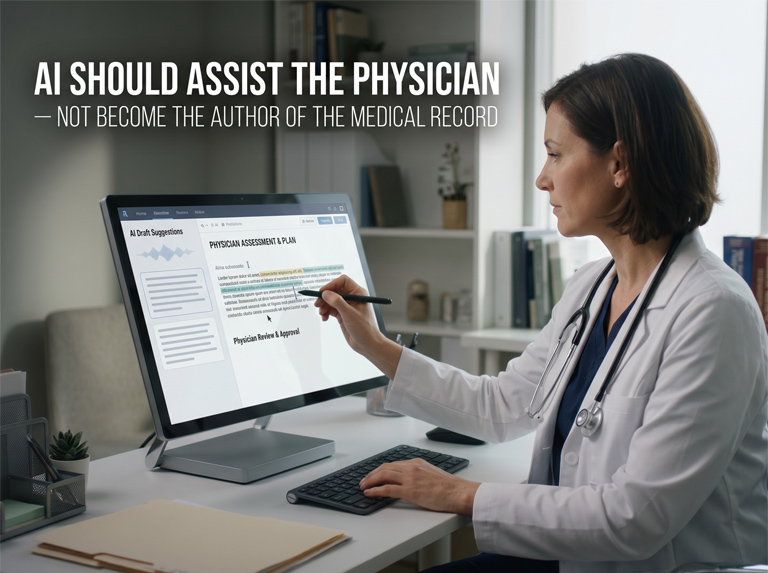
In traditional documentation, the physician is the author—the origin of clinical thought and decision-making.
With AI scribes layered onto templates, that role begins to erode:
- The AI generates the narrative
- The template reshapes it into structured fields
- The physician is left reviewing and editing
Over time, the physician becomes less of an author and more of an auditor.
This shift is subtle—but significant. When authorship is diluted, so is accountability, clarity, and the integrity of the medical record.
Pitfall #2: The Illusion of Accuracy
AI-generated notes often appear polished, complete, and well-structured—especially when formatted into templates.
But presentation is not the same as accuracy.
Common issues include:
- Misinterpretation of patient statements
- Missing or underemphasized clinical details
- Incorrect assumptions introduced by AI
- Overgeneralized summaries that lose nuance
Because the output looks professional, errors are more likely to be overlooked. This creates a false sense of security—one of the most dangerous failure modes in clinical documentation.
Pitfall #3: Hallucinations and Template Propagation
AI scribes can occasionally generate content that was never stated—commonly referred to as hallucinations.
Within a template-driven system, these errors don’t just exist—they persist.
- Templates encourage copy-forward behavior
- Incorrect data can be reused across visits
- Small inaccuracies compound over time
What begins as a minor discrepancy can evolve into a longitudinal documentation error, affecting future care decisions and clinical interpretation.
Pitfall #4: Increased Editing Burden
AI scribes are often positioned as time-saving tools. In reality, when combined with templates, they frequently shift the burden rather than eliminate it.
Physicians must:
- Carefully review AI-generated notes
- Reconcile inconsistencies with structured fields
- Correct errors, omissions, and misinterpretations
Instead of writing notes, physicians spend their time verifying and correcting them—a cognitively taxing process that can be just as time-consuming.
Pitfall #5: Workflow Fragmentation
Templates and AI scribes operate on fundamentally different models:
- Templates rely on structured, predefined inputs
- AI scribes generate unstructured, narrative content
This mismatch creates friction:
- Data does not map cleanly into template fields
- Physicians must manually reorganize information
- Workflow becomes disjointed and inefficient
Rather than streamlining documentation, the system introduces additional layers of complexity.
Pitfall #6: Legal and Compliance Exposure
The medical record is not just a clinical document—it is a legal one. It must clearly reflect:
- Clinical reasoning
- Medical necessity
- Physician intent
Template + AI scribe systems can obscure all three.
Key concerns include:
- Ambiguity around authorship
- Documentation that does not fully support decisions
- Inconsistencies between narrative and structured data
In the event of an audit or legal review, these gaps can become liabilities.
Pitfall #7: Erosion of Clinical Thinking
Perhaps the most subtle—and most concerning—risk is the long-term impact on how physicians think.
When documentation becomes:
- Automated
- Template-driven
- AI-generated
There is a gradual shift away from active, reflective clinical reasoning.
Over time:
- Physicians may rely more on generated content
- Less attention is given to precise documentation
- Clinical thinking becomes less explicitly captured
Medicine risks becoming more reactive than reflective—a fundamental departure from high-quality care.
Why This Matters for Patient Care
Documentation is not a clerical task—it is a core component of patient care.
When documentation is flawed:
- Communication between providers suffers
- Clinical histories become unreliable
- Decision-making is compromised
Ultimately, the quality of the medical record directly impacts the quality of care.
A Better Path Forward
The problem is not that technology is being used—it’s that it is being applied in the wrong way.
Layering AI scribes onto template systems is an incremental fix to a structural problem. What’s needed instead is a fundamentally different approach:
- Systems that adapt to the physician—not the other way around
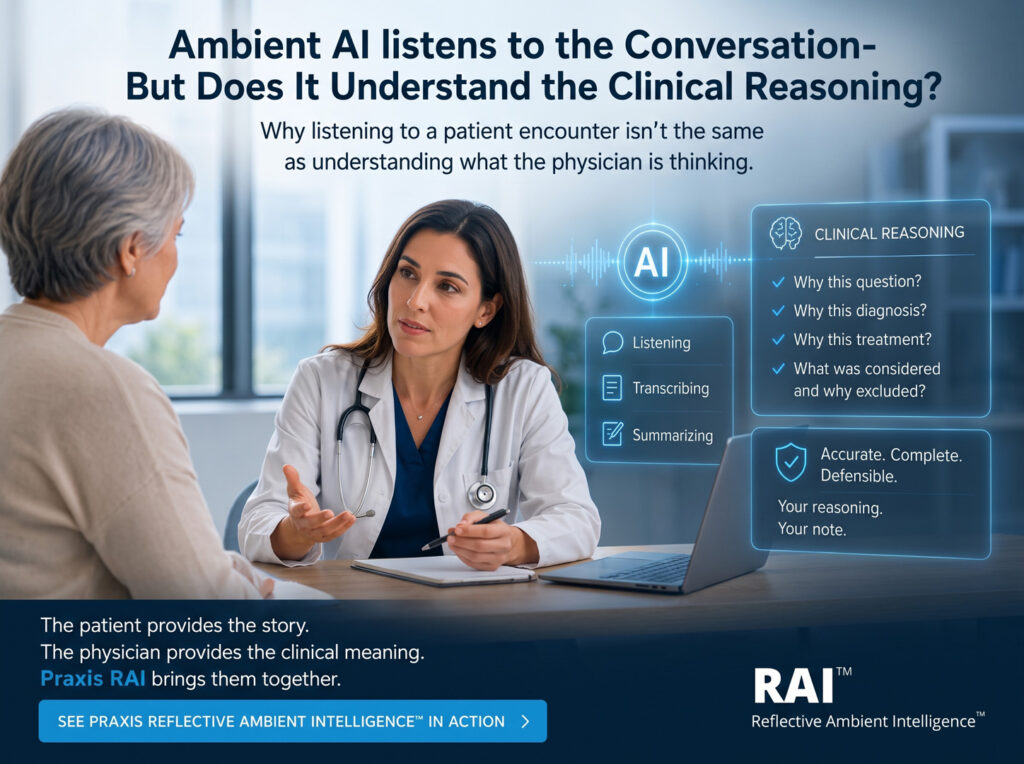
- AI that understands clinical reasoning—not just conversation
- Workflows that preserve authorship and intent
The Future of Clinical Documentation
The next generation of EHR systems must move beyond:
- Rigid templates
- Passive transcription
Toward:
- Intelligent, adaptive systems
- Physician-centered design
- Documentation that reflects real clinical thinking
This is not just a technological shift—it is a philosophical one.
Final Thought
Combining template EHRs with AI scribes may appear to modernize healthcare documentation—but in practice, it often compounds inefficiencies and introduces new risks.
Physicians deserve more than layered workarounds. They need systems built for the reality of medicine: complex, nuanced, and deeply human.
The safest and most effective documentation is not the fastest or the most automated—it is the one that accurately reflects the physician’s mind, preserves clinical intent, and supports better patient care.