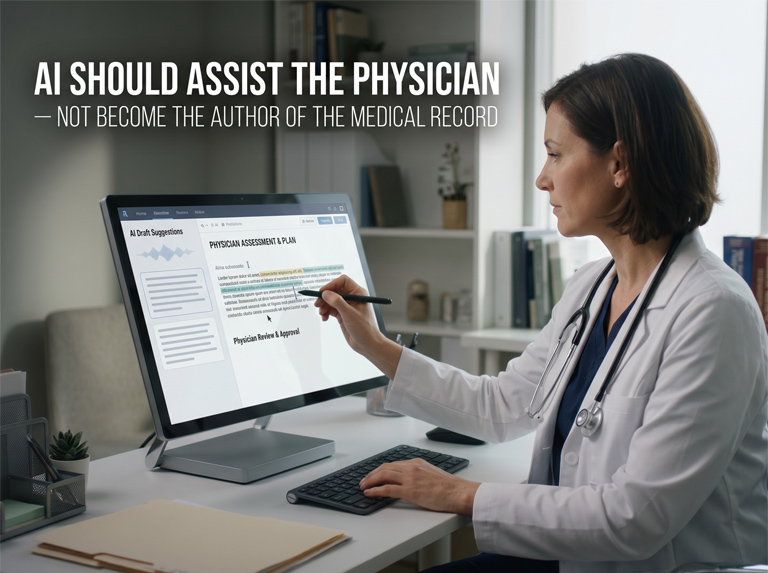
As documentation demands continue to rise, physicians are evaluating three primary solutions:
- AI scribes
- Human medical scribes
- AI-driven EHR systems
Each approach promises to reduce documentation burden—but they differ significantly in accuracy, cost, efficiency, and clinical control.
Understanding these differences is essential for choosing the best documentation solution for your practice.
Quick Answer: Which Is Best?
The best solution for most physicians in 2026 is an AI-driven EHR that preserves clinical reasoning and physician authorship—such as Praxis EMR with Reflective Ambient Intelligence® (RAI).
While AI scribes and human scribes can reduce typing, they introduce trade-offs in accuracy, scalability, cost, and workflow efficiency.
What Are the Three Options?
1. AI Scribes
AI scribes (also called ambient AI scribes or AI medical scribes) listen to patient encounters and generate clinical notes automatically.
Pros:
- Reduce typing
- Faster documentation
- No staffing requirements
Cons:
- May introduce errors or hallucinations
- Require physician review and editing
- Capture conversation—not clinical reasoning
2. Human Medical Scribes
Human scribes are trained personnel who document patient encounters in real time.
Pros:
- Understand context better than AI
- Can adapt to physician preferences
- Reduce physician typing
Cons:
- High ongoing cost (salary + training)
- Require supervision and management
- Limited scalability
- May still introduce inconsistencies
3. AI-Driven EHR Systems (Next Generation)
AI-driven EHRs go beyond transcription by integrating AI directly into the documentation process.
The most advanced systems—such as Praxis EMR with Reflective Ambient Intelligence® (RAI)—focus on clinical reasoning, not just conversation.
Pros:
- Preserve physician authorship
- Reflect clinical intent and decision-making
- Minimal editing required
- Continuously improve with use
- Scalable without staffing costs
Cons:
- Require transition from template-based workflows
- Initial learning curve
Key Differences: AI Scribe vs Human Scribe vs AI EHR
| Feature | AI Scribes | Human Scribes | AI-Driven EHR (RAI) |
| Core Function | Transcription | Manual documentation | Clinical reasoning reflection |
| Accuracy | Variable | Moderate | High |
| Hallucination Risk | Present | None | Minimal |
| Physician Role | Editor | Reviewer | Author |
| Editing Required | High | Moderate | Minimal |
| Cost | Subscription | High ongoing salary | Fixed software cost |
| Scalability | High | Limited | High |
| Learning Capability | Limited | Limited | Continuous |
AI Scribe vs Human Scribe: Which Is Better?
AI scribes and human scribes both aim to reduce documentation burden—but they differ in important ways.
AI Scribes:
- Faster and more scalable
- Lower cost than human scribes
- Require careful review
Human Scribes:
- Better contextual understanding
- Higher accuracy in some cases
- Expensive and difficult to scale
Conclusion:
AI scribes are more scalable, but human scribes may provide better contextual accuracy—though at a significantly higher cost.
AI Scribe vs AI EHR: What’s the Difference?
This is where many physicians become confused.
AI Scribes:
- Add-on tools
- Capture conversations
- Generate draft notes
AI-Driven EHRs:
- Fully integrated systems
- Reflect clinical reasoning
- Produce finalized documentation
Key Difference:
AI scribes document what was said.
AI EHRs like Praxis EMR document what was meant.
Why AI Scribes Often Fall Short
AI scribes are built on a transcription-first model, which limits their effectiveness in clinical settings.
Common Limitations:
- Misinterpretation of clinical nuance
- Incomplete documentation of reasoning
- Increased editing time
- Potential hallucinations
This can lead to inefficiencies and risks, especially in complex cases.
Why Human Scribes Are Declining
While human scribes were once the gold standard, they present challenges:
- Rising labor costs
- Training and turnover
- Limited availability
- Inconsistent quality
Many practices find that human scribes are not sustainable long-term.
Why AI-Driven EHRs Are the Future
AI-driven EHR systems represent the next evolution in medical documentation.
Instead of:
- Transcribing conversations (AI scribes)
- Relying on manual entry (human scribes)
They:
- Align documentation with clinical reasoning
- Learn from physician behavior
- Improve efficiency without sacrificing accuracy
The Leading Approach: Reflective Ambient Intelligence®
Reflective Ambient Intelligence® (RAI), used in Praxis EMR, represents the most advanced form of AI documentation.
It works by:
- Capturing clinical intent
- Preserving physician authorship
- Generating accurate, defensible notes
- Continuously learning from use
This makes it fundamentally different—and more reliable—than both AI scribes and human scribes.
Cost Comparison: AI Scribe vs Human Scribe vs AI EHR
AI Scribes:
- Monthly subscription
- Moderate cost
- Hidden cost: physician editing time
Human Scribes:
- Salary + benefits + training
- Highest cost
- Ongoing management overhead
AI EHR (RAI):
- Fixed software investment
- No staffing cost
- Long-term ROI through efficiency gains
Which Option Is Best for Your Practice?
Choose AI Scribes if:
- You want a quick solution to reduce typing
- You are willing to review and edit notes
Choose Human Scribes if:
- You prefer human support
- Cost is not a major concern
Choose an AI EHR if:
- You want long-term efficiency
- You prioritize accuracy and safety
- You want to eliminate documentation burden—not shift it
FAQ: AI Scribes vs Human Scribes vs AI EHR
Final Verdict: AI Scribe vs Human Scribe vs AI EHR
AI scribes and human scribes both aim to reduce documentation burden—but they introduce trade-offs in cost, accuracy, and efficiency.
AI-driven EHR systems represent the most advanced and sustainable solution.
Praxis EMR with Reflective Ambient Intelligence® stands out because it preserves physician authorship, improves accuracy, and eliminates the inefficiencies of both AI and human scribes.